


Side 01 — the canal narrows
Bone spurs, thickened ligament, dried-out discs
Osteophytes build up, the ligamentum flavum thickens, and the discs lose their water. The canal your nerves run through gets physically smaller.
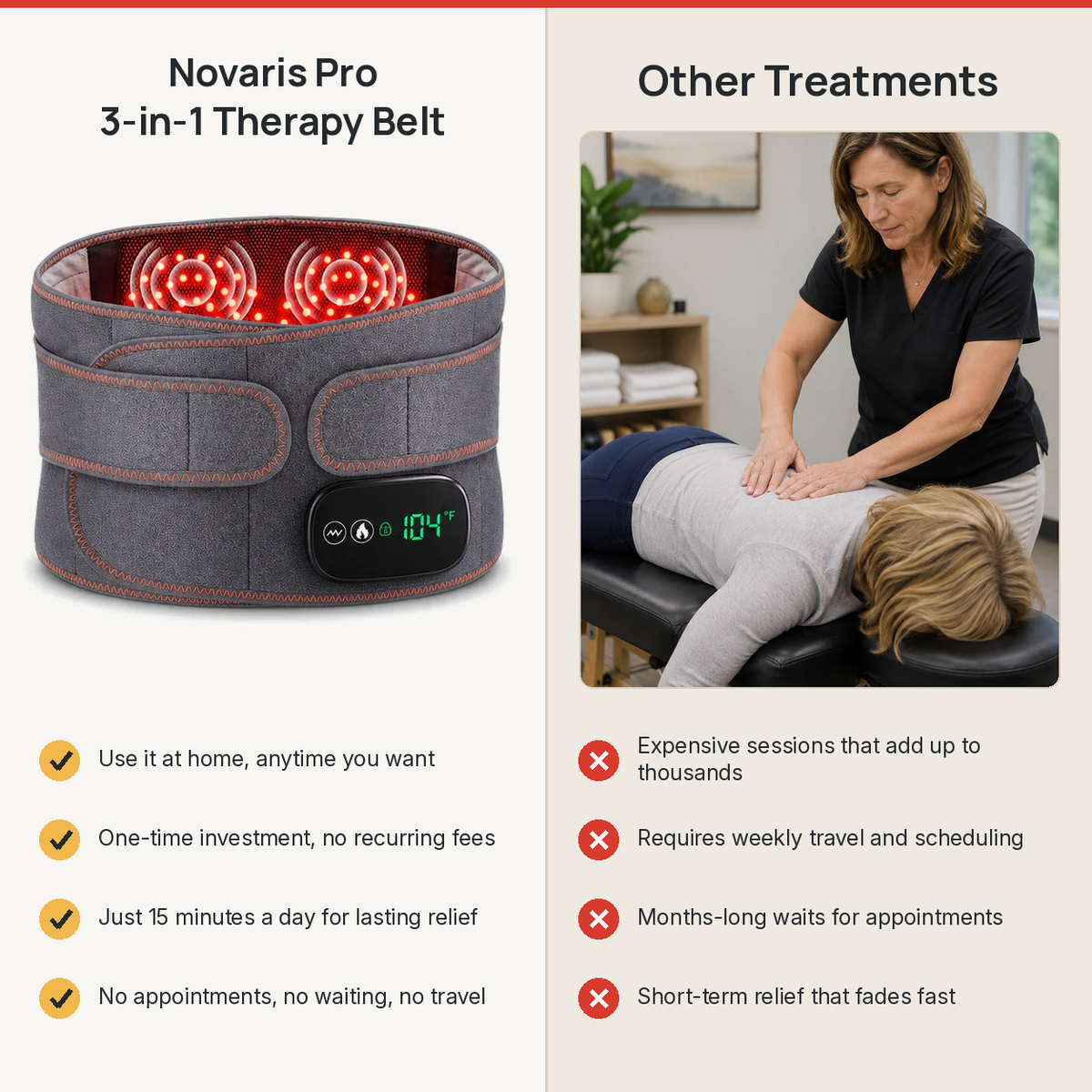
The cordless heat + massage + red and near-infrared light belt, reverse-engineered from the $14,000 clinic machine, that reaches the locked multifidus muscle pushing your vertebrae into the narrowing canal, restores the choked blood flow, and recharges the dead cells that keep the canal compressed. No pills. No shots. No laminectomy. No billing code.
Order today, arrives -
Couldn't load pickup availability

"Sixteen years reading MRI scans, and I never thought I'd be the one taking my mother off the surgery list. After eight weeks with this belt, her surgeon told her he'd be reluctant to operate on a back that had improved this much. She canceled the laminectomy."
You feel warmth and massage from the very first session. Most customers notice real change within 3–5 days — standing time improves first, then sleep, then walking distance. Deeper muscle release builds over 6–8 weeks.
1. Better than a drugstore heating pad
A heating pad warms the skin surface only. It has no massage and no light therapy, it is corded, and it cannot reach the multifidus 2–3 inches down. Novaris Pro reaches the muscle that is actually causing the compression — and because it is cordless and wearable, people keep using it instead of abandoning it in a drawer within a month.
2. Better than painkillers (Aleve / Advil / Prilosec)
NSAIDs go through the gut, never reach the deep multifidus, and wear off. Long-term daily use risks gastritis, ulcers, liver and kidney strain — which is why so many users are also on a stomach protector. Novaris Pro is drug-free, bypasses the stomach entirely, is non-habit forming, and works on the cause rather than the signal.
3. Better than gabapentin / Lyrica
These sedate the whole body to dull one signal. Customers report brain fog, weight gain and dependence. Novaris Pro dulls nothing — it releases the muscle and restores circulation locally, with no cognitive side effects.
4. Better than a TENS unit
A TENS unit zaps surface nerves. It does not reach the deep multifidus and it does not recharge cells. Novaris Pro combines three modalities and works at depth.
5. Better than physical therapy
PT can involve a 14-week wait, 12–20 sessions, repeated courses, weekly travel and scheduling, and $2,000–$7,500 over five years post-insurance. It also does not deliver deep heat between sessions. Novaris Pro is the clinic machine, at home, every night, with no appointment.
6. Better than epidural steroid injections
Injections reach deep, but relief shrinks each round — six weeks, then three, then one — and long-term cortisone thins tissue. At $600–$2,000 per injection, 2–4 times a year, that is $6,000–$40,000 over five years. Novaris Pro is a one-time $119 with no tissue thinning and can be used alongside injections.
7. Better than a chiropractor
A chiropractic adjustment is mechanical only — it feels great, and by morning the muscle has pulled everything back. At 2x weekly it costs $6,000–$18,000 over five years. Novaris Pro addresses the muscle that keeps undoing the adjustment.
8. Better than an inversion table
Bulky, takes up an entire room, unsafe for high blood pressure or glaucoma, and causes dizziness, eye pressure or nausea. It offers spinal decompression only — no heat, no massage, no light. Novaris Pro is compact, wearable anywhere, safe for all ages including 70+, and combines all three therapies.
9. Better than a laminectomy
Surgery cuts the bone — one side of the loop. It leaves the multifidus locked and the circulation choked, which is why a meaningful share of patients still hurt afterwards, with roughly a 35% chance numbness returns, plus NSAIDs post-op. Novaris Pro is non-invasive, works the other three sides, and is used by customers both while waiting for surgery and after it.
10. Better than doing nothing while you wait
The strongest positioning line: "Fix what the MRI cannot see." Every week on a waiting list is a week the loop tightens. Novaris Pro gives the customer something to do tonight, in their own chair, for 15 minutes — while they still have options.
Novaris Pro is an electronic wellness device and contains no consumable ingredients.
Materials
Inside the box
Shipping: Free standard shipping on all U.S. orders. Ships within 3-7 business days.
Returns: 60-day hassle-free return policy. If you're not satisfied, send it back for a full refund — no questions asked.
Have questions or need assistance? Reach out us 24/7 via email or phone number:
Email: help@trynovaris.com
Phone: +1 (719) 247-2172



“Three thousand lumbar scans. Every one of them showed the bone. Not one of them showed the muscle strangling it. They cut what the scan shows and send you home with the rest of it still locked in the dark. This is the only thing I've seen break the loop.”
This is why the injection wears off, why the pills stop working, and why so many people still hurt after surgery. Each treatment opens one side of the loop. The other three close it again.
Osteophytes build up, the ligamentum flavum thickens, and the discs lose their water. The canal your nerves run through gets physically smaller.
Two to three inches beneath the skin, the deep stabiliser muscle goes into permanent spasm trying to protect the spine. In doing so it pulls your vertebrae closer together and makes the narrowing worse.
Oxygen can't get in. Inflammatory waste can't get out. So the waste sits on your nerve endings and burns them like acid — which is the burning, the tingling and the numbness running down your leg.
Starve a cell of oxygen long enough and the mitochondria stop producing ATP. Without ATP a muscle cannot release, no matter how badly you want it to, and the tissue cannot repair. Now the loop feeds itself.
Reverse-engineered from the $14,000 machine bolted to a physical-therapy clinic floor — and rebuilt to sit on your waist while you watch television.
Adjustable thermal therapy up to 150°F (65°C) that penetrates two to three inches — deep enough to reach the multifidus, not just warm the skin like a drugstore pad.
What you'll feel: the deep grip in your lower back loosening for the first time in months. The constant tension that's been there for years, melting.
Multiple pulsing modes that break the spasm-pain-spasm cycle mechanically and pump stagnant paraspinal tissue so inflammatory waste can finally drain.
What you'll feel: the burning down the legs easing off. Standing at the sink becomes possible again.
Photobiomodulation using the same wavelengths NASA studied for tissue repair. It passes into the cell and restarts the mitochondria that went dark.
What you'll feel: the burning down the legs cooling. The numbness when you stand up from the recliner, gone.

Heat reaches 2–3 inches into the lumbar region

Improves local circulation & releases the muscle pushing into your canal

Soothe your lower back while you sit, work or drive

Built for stenosis, discs, sciatica, muscle tension, pinched nerves
Not a miracle, and not overnight. This is the order it happens in for most people — and the specific moment in each stage where they notice.
Fifteen minutes in, the heat has reached far enough down that the muscle stops bracing. Nothing is healed yet. But for the first evening in a long time, your back is not the loudest thing in the room.
Standing time goes first — it is almost always the first thing to move. You notice it at the kitchen counter, or in a checkout queue: the point where you normally start looking for something to lean on arrives later than it used to.
Sleep tends to improve ahead of daytime pain, which surprises people. You stop waking at three in the morning to shift position, and you stop planning tomorrow around how badly you slept.
This is where the deeper muscle release shows up. The driveway, then the block, then the shops. Many customers reduce their daily NSAIDs somewhere in here — tell your doctor before you change anything you were prescribed.
Most heating pads end up in a drawer within a month. This one tends not to, because the session is short, warm and yours — the part of the evening nobody needs anything from you.
The pattern behind all five: the people whose backs keep changing are the people who keep using it. Fifteen minutes is short enough to survive a bad week — which is the whole reason it was built to sit on your waist instead of a clinic floor.
Wrap the cordless belt around your lower back, just above the belt line, so the panel sits over L4–L5. Tighten the strap. It works over or under clothing.
Power on and pick your heat level and massage mode on the touchscreen. Start on low or medium for the first few sessions.
Read, watch television, work at a desk, or walk around the house. The timer ends the session for you. Once a day is the whole routine.
Against everything you've already tried

"For thirty-two years, I told patients to tough it out. Then my wife Sophie's burning started. I watched the system fail the person I loved most. The protocol wasn't built to fix her. It was built to manage her while they waited to cut. I retired to fix what I had been part of."

"I spent two decades building the $14,000 heat and light machines bolted to clinic walls. My father asked me one question: 'Why does the patient go home with a pill instead of the machine?' I had no good answer. So I built the machine into a belt. Same technology. Same wavelengths. One-tenth the size. No wall required."

“A laminectomy addresses the bone — one side of the problem. It doesn't touch the locked multifidus or the local circulation that keep the nerve inflamed. That is why so many of my patients still hurt afterward.”

“Heat, vibration and red and near-infrared light together do something none of them do alone. For stenosis patients, that combination is genuinely useful between sessions.”

I was seventy-one, told my stenosis was "irreversible" and that I needed to "learn to live with it." I used the belt every evening for eight weeks. At my pre-op, my surgeon reviewed my new imaging and told me he would be reluctant to operate on a back that had improved this dramatically. I asked to come off the schedule. He said yes. The coordinator asked me twice if I was sure. I was sure. I'm back kneeling in my garden again.
I was a retired teacher. The numbness started in my legs. I tried everything Medicare offered. Pills, shots, the walker. Nothing held. Thomas gave me the belt. Three weeks later I called him crying. I had slept through the night for the first time in four years. I had forgotten what it felt like to wake up without dread.
I'd been signed up for a laminectomy. I used the belt every evening for six weeks. At my pre-op, the surgeon looked at my scans and told me the nerve compression had resolved enough to take me off the schedule. The surgical coordinator asked me twice if I was sure. I was sure. I walked out of that office with my calendar clear for the first time in two years.
I had been using a walker for two years. The stenosis diagnosis felt like a life sentence. I used the belt every evening for six weeks. One morning I walked to the end of my driveway and back. Without the walker. For the first time in twenty-four months. My wife filmed it. We both cried.
You feel warmth and massage in the first session. Most people notice real change within three to five days — standing time improves first, then sleep, then walking distance. Deeper muscle release builds over six to eight weeks.
Yes. It is drug-free and does not interact with medication. Many customers use it while taking Aleve, Prilosec, gabapentin or amitriptyline, and reduce their daily NSAID use within weeks. Tell your doctor you have started using it.
No — it does not change bone structure, and anyone who tells you a belt can is not being straight with you. It releases the locked multifidus, restores blood flow and recharges drained cells. Pain and numbness can retreat and function can improve even when the bone on your scan looks the same.
Many customers do. Some find enough relief to come off the list; others use it before and after surgery to reduce their need for NSAIDs. Always tell your spine specialist what you are using.
Yes. It works through a different mechanism and does not interact with cortisone. Many customers start four to six weeks after an injection, as the cortisone wears off.
Heat is adjustable up to about 150°F (65°C) from the touchscreen, and most people start on low or medium. There is an anti-mistouch lock and an automatic shut-off timer. If you have reduced skin sensation — diabetic neuropathy, for example — start on the lowest setting and speak to your doctor first.
The built-in 5000mAh battery is fully cordless and charges with the included USB-C cable, like a phone. One charge covers many fifteen-minute sessions — up to thirteen hours of use. Most people charge it every few days.
The adjustable elastic strap fits most waists. It sits across the lower back and wraps around the front, and can be worn over or under clothing. Contact us before ordering if you have any concern about fit.
Both. Roughly 55% of owners are women and 45% men, and the core age range is late fifties to mid eighties. About three in ten orders are placed by a spouse, son or daughter buying for someone else.
A drugstore heating pad warms skin — no massage, no light, and a cord. A TENS unit buzzes surface nerves and never reaches the deep multifidus or recharges a cell. Novaris Pro runs all three therapies at two to three inches of depth, cordless.
No. It is sold on this site only. There is no CPT billing code and no prescription route. Keeping it out of retail is what holds the launch price at $119.
60 days, full refund, no questions. The one-year warranty covers device defects separately.